
Craig Pindell, Fine Art Photographer
All work copyright Craig Pindell, 2026
Building the CP617b
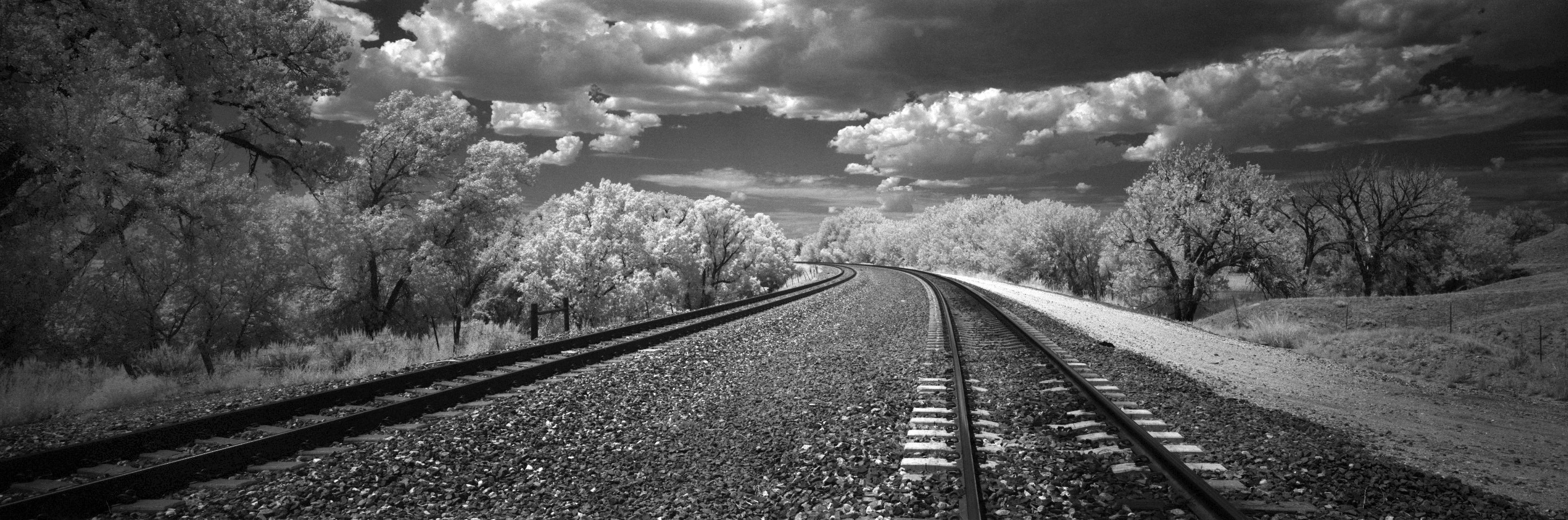
Whalen Dam Railroad Tracks - Infrared CP617b camera, 58mm Super Angulon lens, Rollei Infrared film
The 6x17 format is one of my favorite formats. It is versatile and it uses roll film, so there is a large variety of film stock available. 90mm Super Angulon lenses are readily available on the used market and for my it is a terrific choice for 617 work, just wide enough to be interesting.
Unfortunately, 617 cameras are very expensive. There have been beautiful cameras from Horseman and Fuji, but they are tough to come by at a reasonable price. I purchased a Da Yi back for my 4x5 camera and used it with limited success. I purchased a Da Yi 5x7 back and had Bomm make me a 5x7 adapter for my 8x10 camera, and that combination made terrific images and was fun to use, but it was heavy and slow.
I wanted to have a more spontaneous alternative to using my 8x10 to make 617 panoramas. Some time ago I built a kit from the Two Fourths company. (You can read about that build here). It was a challenging build, and the results weren't always what I hoped they would be. I decided to try to build something on my own.
As I designed the camera in my head, the film transport system was always a hurdle. One of the most aggravating parts of the Two Fourths camera was the film transport system. Fat rolls, scratched film, film flatness issues - all happening at the most inopportune times. My starting point was sorting that part out, and the rest would be easy.
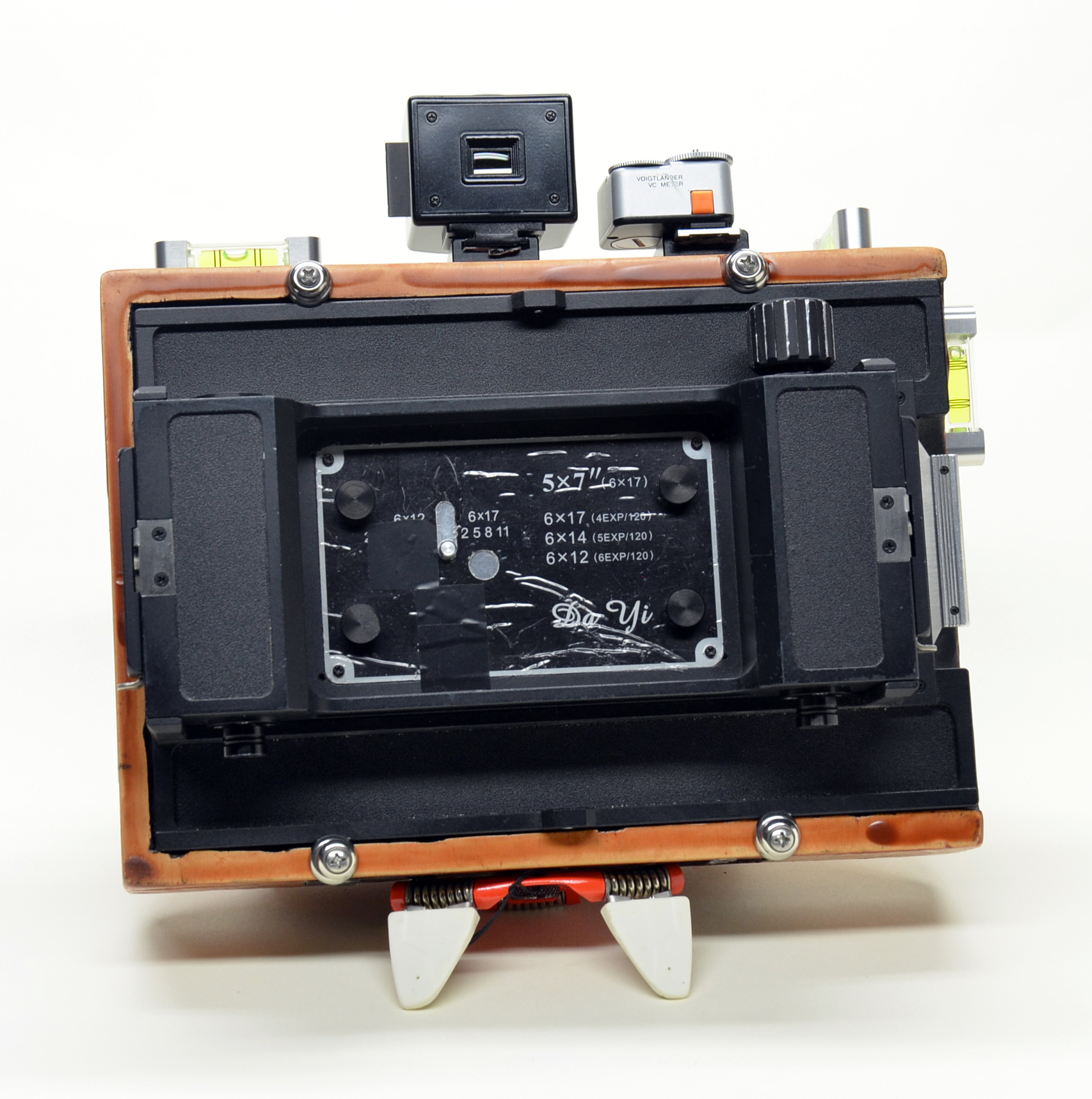
Da Yi Panorama 5x7 back. I taped over the openings for the formats other than 617 to avoid confusion.
The answer to my problems was the Da Yi 5x7 film back I was using on my 8x10 camera. It worked fine for that, all I had to do was make a camera that was lighter and more nimble to use that back. At times it is a bit fussy to load, but on the whole this back is so much better that the Two Fourths, it is worth the effort. Another advantage of the Da Yi back over the two fourths is that due to the included dark slide, it is possible to change lenses mid roll. With the Two Fourths camera, lens changes were only possible between rolls.
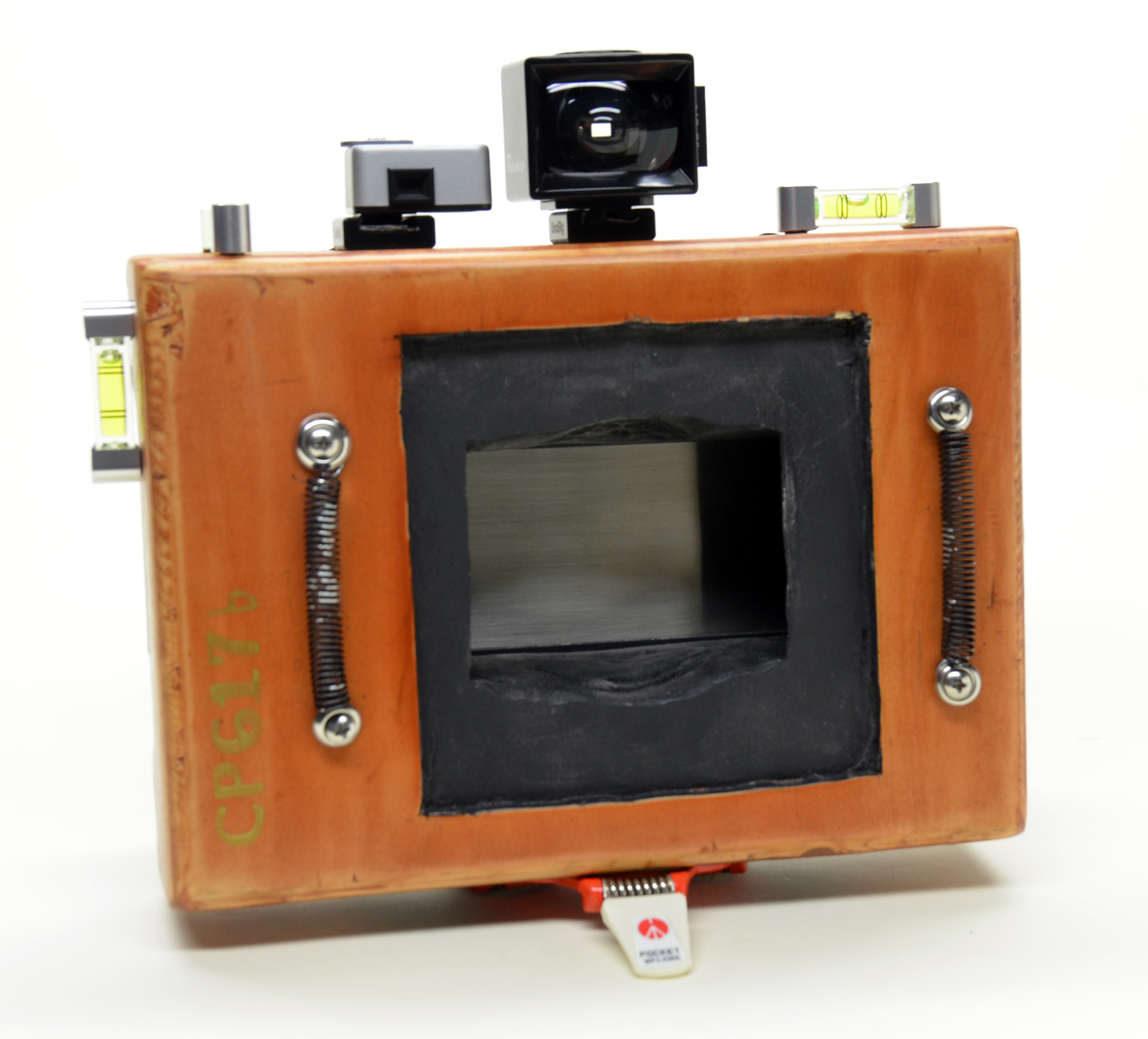
Front view of the CP617b Camera, with lens removed.
To build this camera, I glued together 3 pieces of 3/4 inch maple plywood (left over wood from my photo van build) that was about 1 1/2 inches larger than the Da Yi back in both height and width. Once the glue was dried, I trimmed this blank to the desired dimensions. I wanted the camera body to be just large enough to hold the back securely. The thickness of the blank was determined by the distance the 58mm lens needed to be from the film plane to be focused at infinity.
I measured several times to find the exact center of where the film opening on the back would be located when the holder was mounted to the body. Once this was marked on the body, I drilled a 3/16 inch hole through the body. I used this as a pilot hole for the hole saw to assure the lens would be exactly aligned in front of the film opening on the back. Using a 2 1/4 inch hole saw I drilled through the body. Using an oscillating multi tool, I enlarged the opening to match the film opening on the Da Yi back, and tapering to the opening required for the lens. It took a bit of effort to be sure the image would not be obstructed.
I used a trim router to recess an area for the lens board to mount into. The offset shape from the lens board to the camera body formed a light proof connection.
I used more scrap plywood to make the lens boards. I used the router to adjust the thickness of the lens board, to get the desired distance from the film plane to the lens board.
I wasn't sure how to attach the lens boards, and I had these springs leftover from another project. They certainly don't add to the aesthetics of the camera, but they do hold the lenses securely and are not effected by cold temperatures.
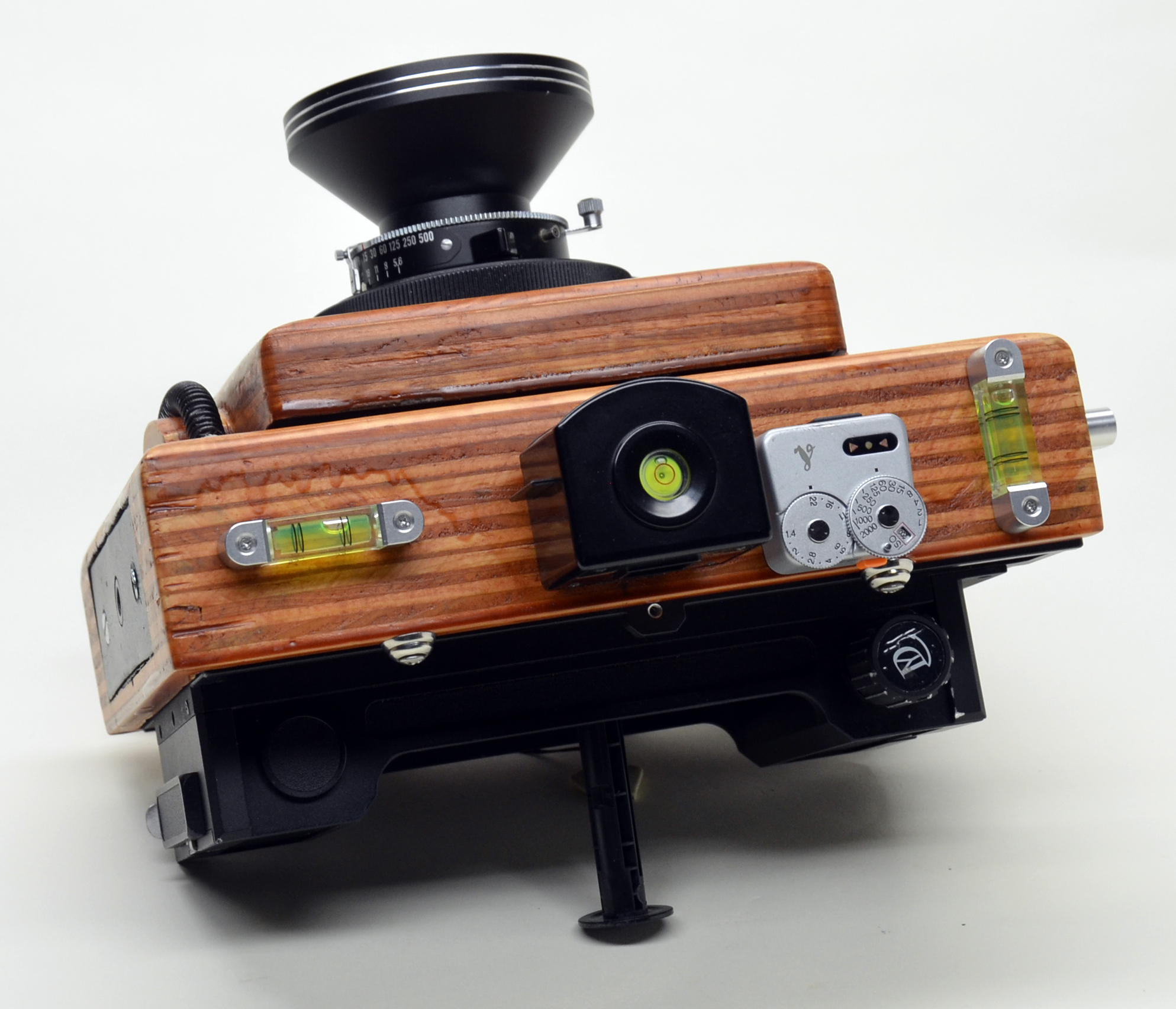
Top view of the CP617b Camera with bubble levels, Fotoman Viewfinder, and Voightlander meter.
The body was also thick enough to allow me to attach the Fotoman viewfinder, the Voightlander meter, and the adjustable bubble levels. The viewfinder is a quick and easy guide for framing, but is not at all exact. It works well for a spontaneous camera, but if I need exact framing, I plan to use the Bomm 8x10 and the adapter to use this same film back.
The Voightlander meter is terrific and easy to use. I still use my spot meter quite a bit of the time, mostly because I am most comfortable photographing that way.
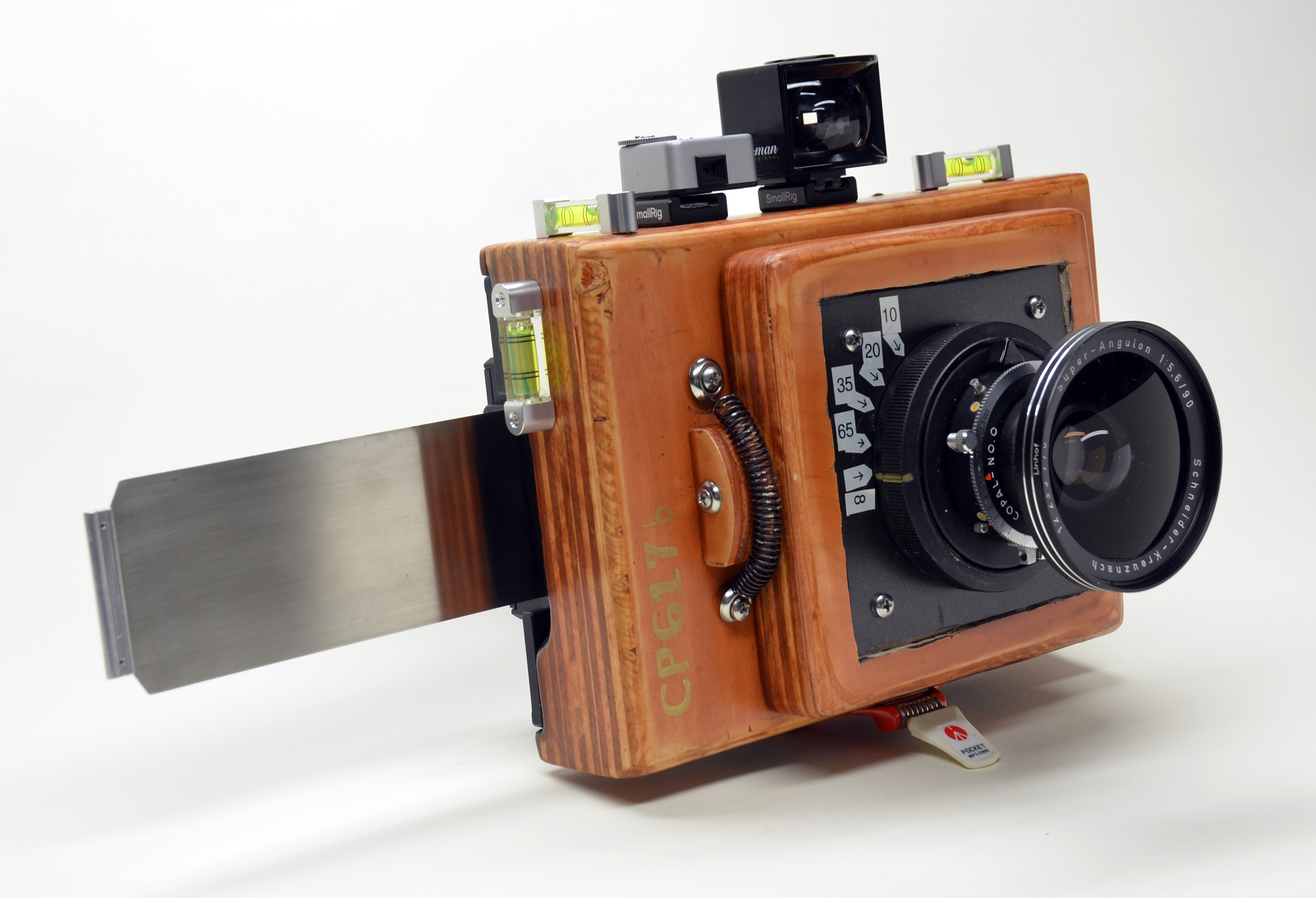
Front view of the CP617b Camera, 90mm lens and dark slide partially out of the Da Yi back.
I used a wood rasp to create a recess in the body to allow for easier manipulation of the dark slide. Inserting the dark slide after each exposure provides an additional protection from fogging of the film should there be a light leak in the body or the lens to body connection. I have not seen any evidence of that, but this camera was assembled fairly quickly from parts on hand, and the tolerances are not at all exact.
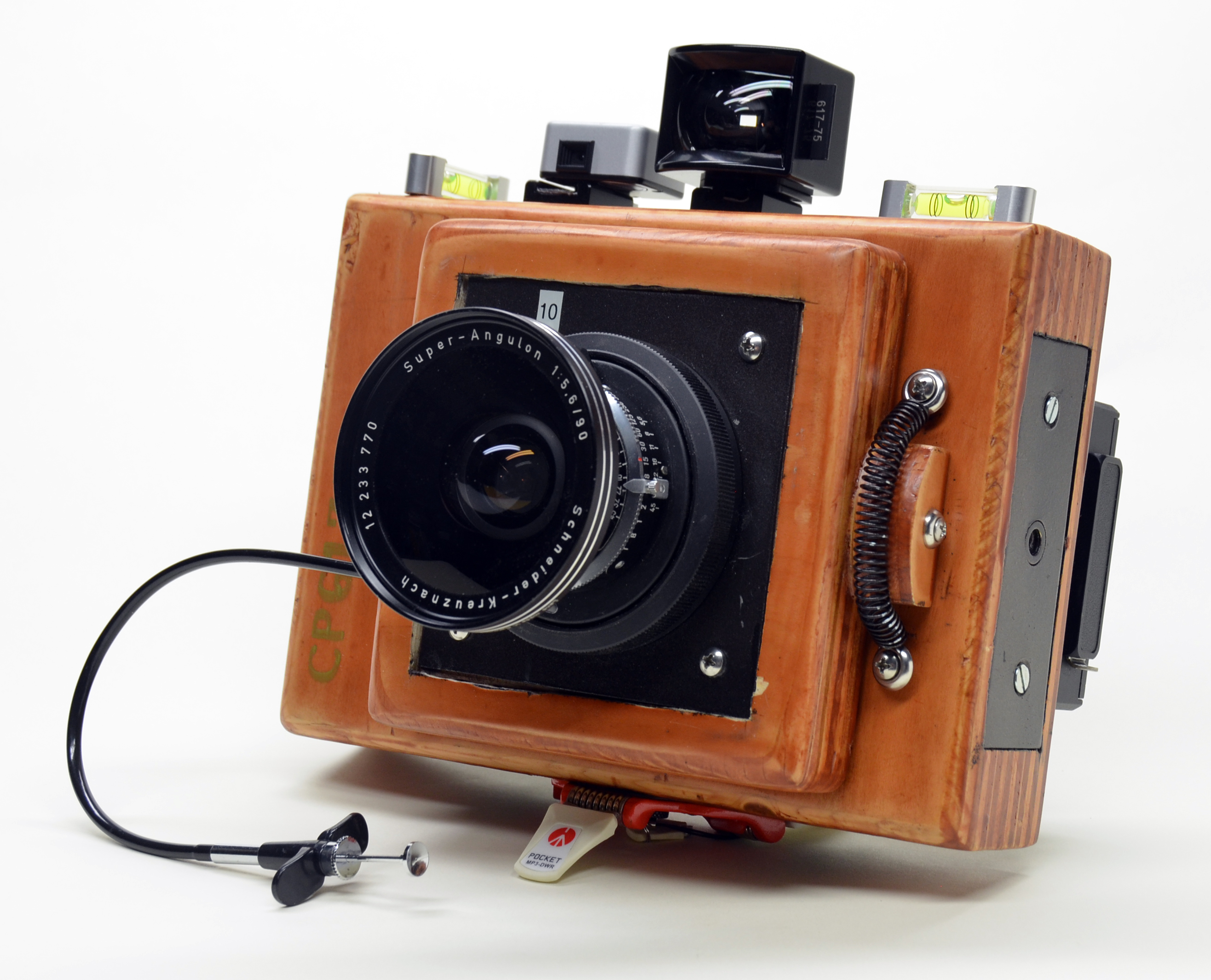
The CP617 and 90mm lens
The CP617b camera has two matching tripod mounts, one on the bottom of the camera body, and one on the the side of the body- opposite of the dark slide. This mount allows the camera to be used vertically. I also added an additional bubble level for the vertical orientation.
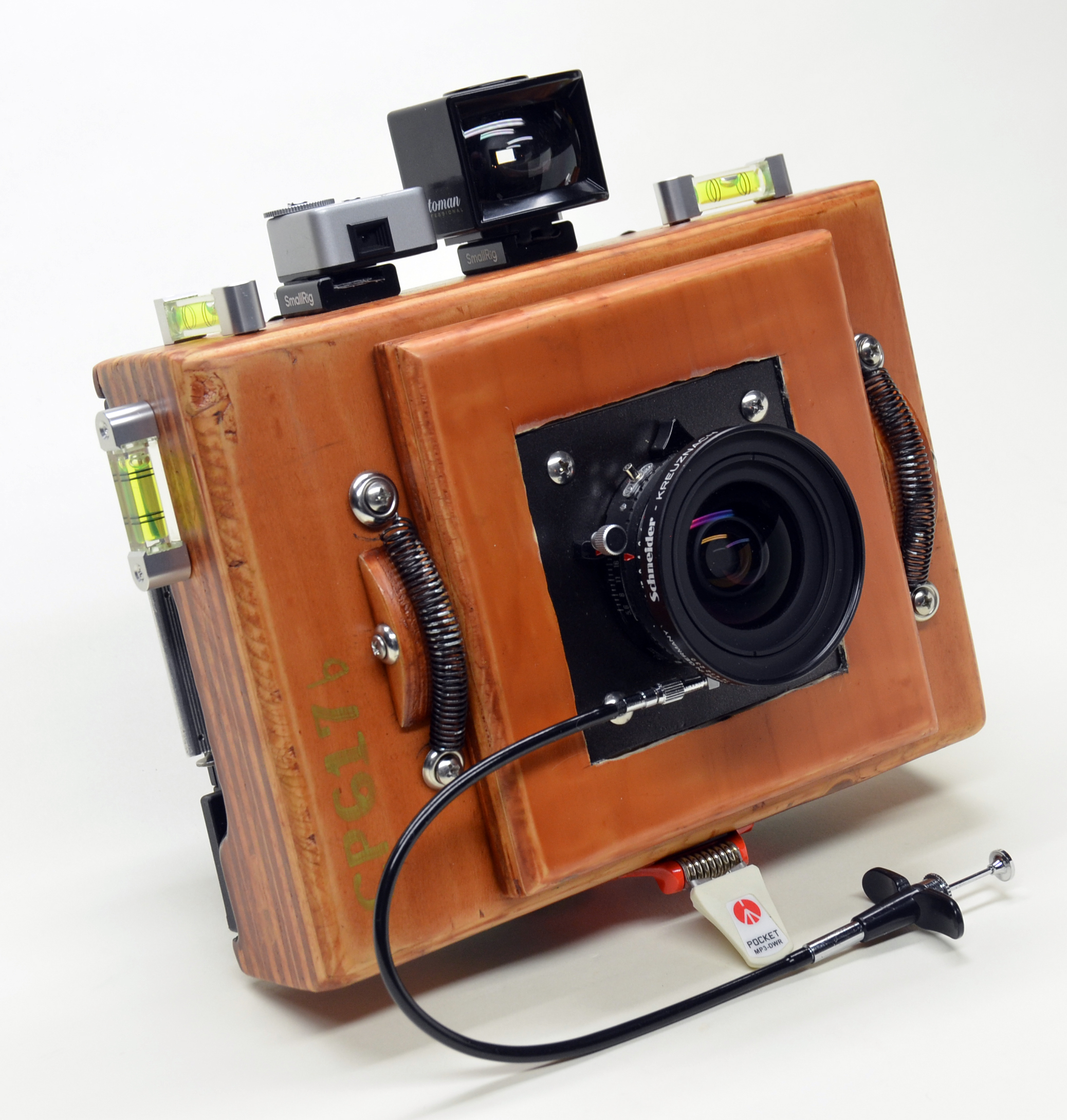
This is the CP617b camera with the 58mm lens attached. The camera is compact and easy to use.
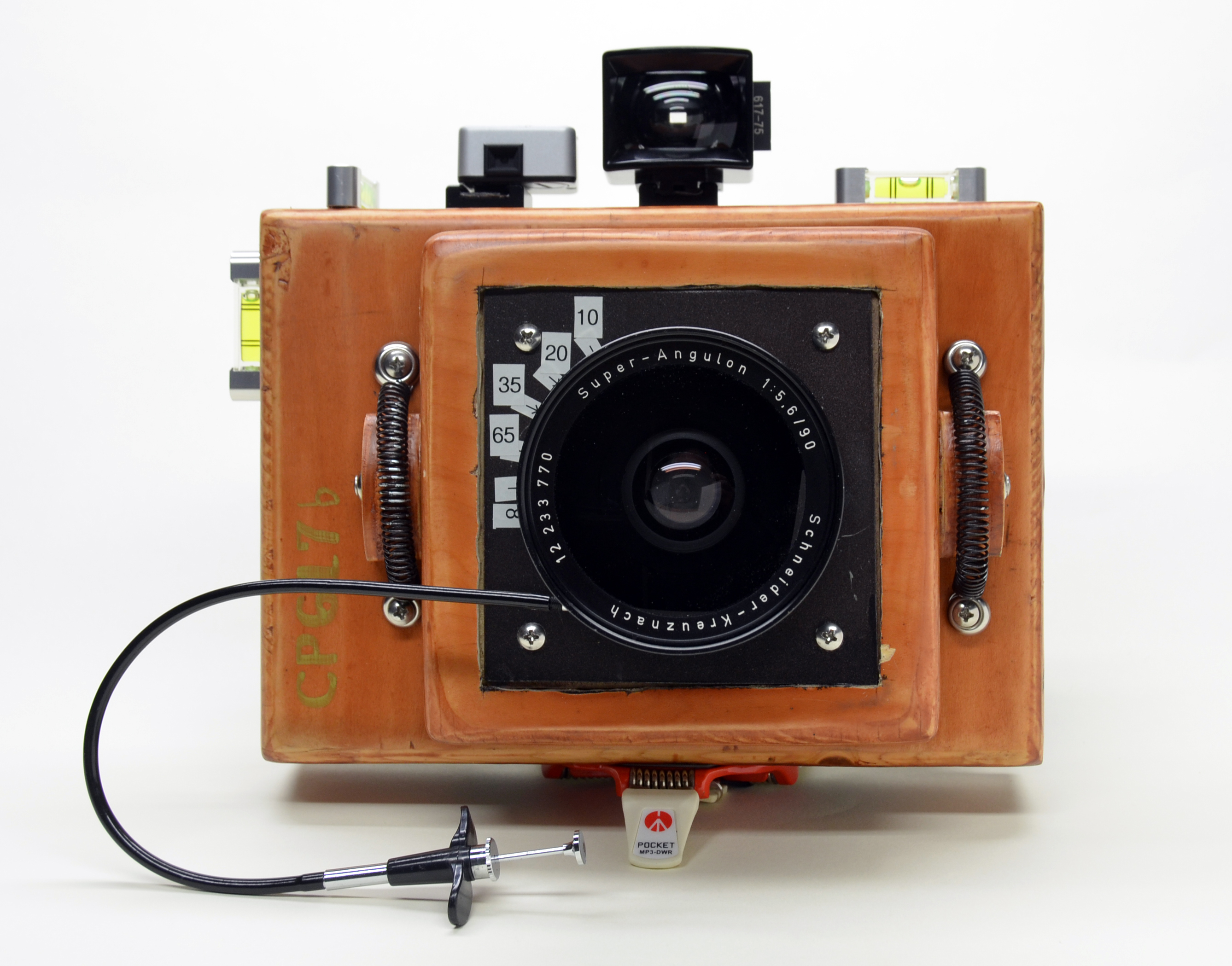
CP617b Camera with 90mm lens attached
The numbers on the lens board are distance setting for the helicoil focusing device. The helicoil and this lens were on the Two Fourths camera, and I transfered them to this camera. For the most part, I leave the focus on infinity, and usually use f/32, counting on the depth of field of the lens to keep everything in focus.
After using this camera for a few months, I truly regret not taking more time to construct it. It really works well, but sure doesn't look great. It is about 1 pound heavier that the Two Fourths camera, but a lot of that weight is the difference between the Da Yi back and the Two Fourths film transport system. The body weighs 4 lbs 7 oz. The camera with film back and 90mm lens weighs 6 lbs 13 oz. The camera with film back and 58mm lens weighs 5 lbs 10 oz.
I have been thinking of building another 617 camera. The next camera will still use the Da Yi back, but rather than plywood I will use dimensional lumber and I will try to work out a way to use Linhof style lens boards - a recessed board for the 58mm, a flat board for the 90mm and I expect I will use the helicoil for a 150mm lens, to better round out my lens options. I am also considering making a ground glass for more precise framing. I think I will spend the money on slides for mounting the back / ground glass, and for the lenses.
All just thoughts at this point, but stay tuned, no telling when I might get the notion to make it into a reality.
Thanks for reading.